


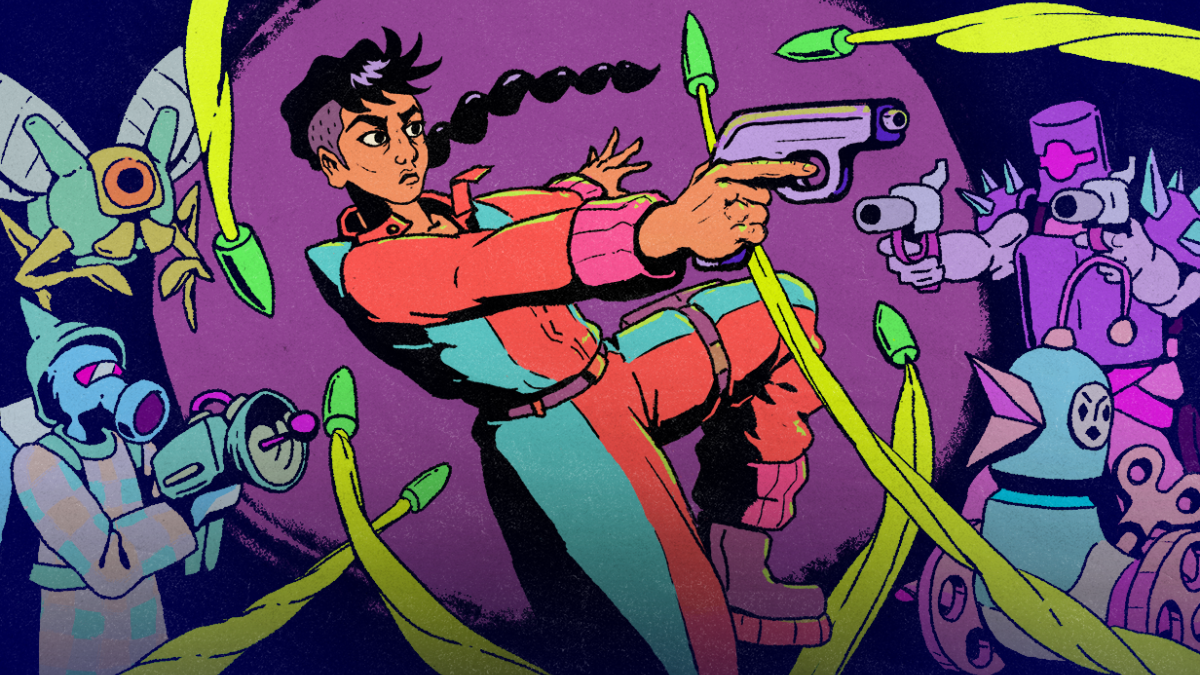
Bullet hell combat can feel very hit or miss, while roguelikes are perhaps the most saturated they’ve ever been. Enter the Chronosphere attempts to combine both genres into one tight package, while likewise blending wild west tropes into a science fiction backdrop. It’s an elevator pitch brimming with potential, yet still deserves a fair bit of cautious optimism. Despite going into the game with this skepticism front of mind, I put the controller down feeling thoroughly impressed.
Enter the Chronosphere takes a page right out of Superhot’s book, with its foundation built on the core mechanic that time only moves when you do. This blatant inspiration never wanders into the realm of feeling derivative, as the games are starkly different in every other way that matters. For example, Enter the Chronosphere is isometric, and embraces a lot of the visual language you would see in a turn-based strategy game. Much of the game is based around managing different kinds of gear, picking your favorites from random drops. In short, Enter the Chronosphere makes the player-based flow of time feel as completely fresh as it did the first time it was introduced.
Enter the Chronosphere’s Tactical Combat Impresses at All Times

Enter the Chronosphere spares no expense when earning the “hell” in bullet hell. There’s no way to frame the game’s difficulty as a gripe without sounding like a scrub, so let’s just say that it’s not for the faint of heart. After withstanding some growing pains, I learned to love the challenge. Combat became genuinely refreshing as I discovered that the systems weren’t punishing me for no reason, but simply incentivizing me to approach problems with a more tactical mind.
There are a few different playable characters, each with their own playstyle. Marcia, the closest thing Enter the Chronosphere has to a default protagonist, boasts a dodge roll as her signature ability. Practically speaking, this allows players to have a get-out-of-jail-free button if they let one of the dozens of threats on screen slip past their notice. Of course, it still operates on a cooldown, so it never becomes as abuseable as a full-blown rewind would be.
It’s certainly worth trying out the other playable characters; the only real shortcoming is that the other characters are missing the key piece of giving you a clear roadmap on how to unlock them. Giving players an objective to complete in order to earn the unlockables would help the gameplay loop feel more rewarding, which is pretty much the biggest hurdle for any roguelike. However, each character does still go the extra mile by offering a unique dimension to already dynamic systems. In fact, this sort of variety is one of the biggest attractions Enter the Chronosphere has to offer.
Probably my favorite aspect of the entire game is the whole host of guns you get to unpack and unload with. For a project that’s still in early access, the sheer diversity of weapons really makes Enter the Chronosphere feel almost complete. More importantly, the options in your arsenal aren’t just plenty. Every single one of them feels worthwhile, and it’s easy to imagine any one of them finding their way into a player’s favorite loadout. Despite fully embracing cowboy antics, the melee weapons proved to be a real standout. They’re often more challenging than any given peashooter, but the high risk is always met with a gleefully high reward.
Story Pacing is a Sore Spot in Enter the Chronosphere
My only real knocks, if you want to call them that, are strongly localized in the story department. Enter the Chronosphere asks players to pause between runs for some brief character interactions. Character design puts in some work to make everyone interesting at a glance, and peeling back the layers of everyone’s personalities reveals them to be as fun to watch as they were to play. However, I think that these story beats aren’t really well integrated into the game as a whole. There isn’t really an “incentive” for players to not just mash through the dialogue and get back into gunslinging. This could simply mean giving characters more evident depth. It could mean giving players more chances to interact during these scenes, like with dialogue options. Or most ambitiously, it could mean spinning some of these into deeper sidequests and giving players direct rewards for fostering the bonds between two characters.
Ironically, there are cutscenes that play before any given run which can’t be skipped. My gut instinct tells me this was just an artistic flourish for some unavoidable loading screens. Still, it felt a little bit hard to stomach when other moments of pause felt so trivial. Ultimately, this contrast made the pacing of the moments around combat feel a bit sloppy at times.
Final Thoughts
Enter the Chronosphere is among the best indie roguelikes I’ve had the pleasure of playtesting. Even this early into development, it’s already clear that the game is jam-packed with enough variety to keep dungeon-crawling worthwhile for hours on end. Unfortunately, the framework around the gameplay feels flimsy despite its prominence. Thanks to gorgeous art for characters and environments alike, one can’t help but be drawn into the world of Enter the Chronosphere. However, there isn’t yet enough incentive to stay enthralled in those precious few cutscenes. Enter the Chronosphere doesn’t yet do enough with its storytelling to earn the title of an instant classic, but its tactical real-time combat makes for a one-of-a-kind roguelike that’s almost impossible to put down.


