


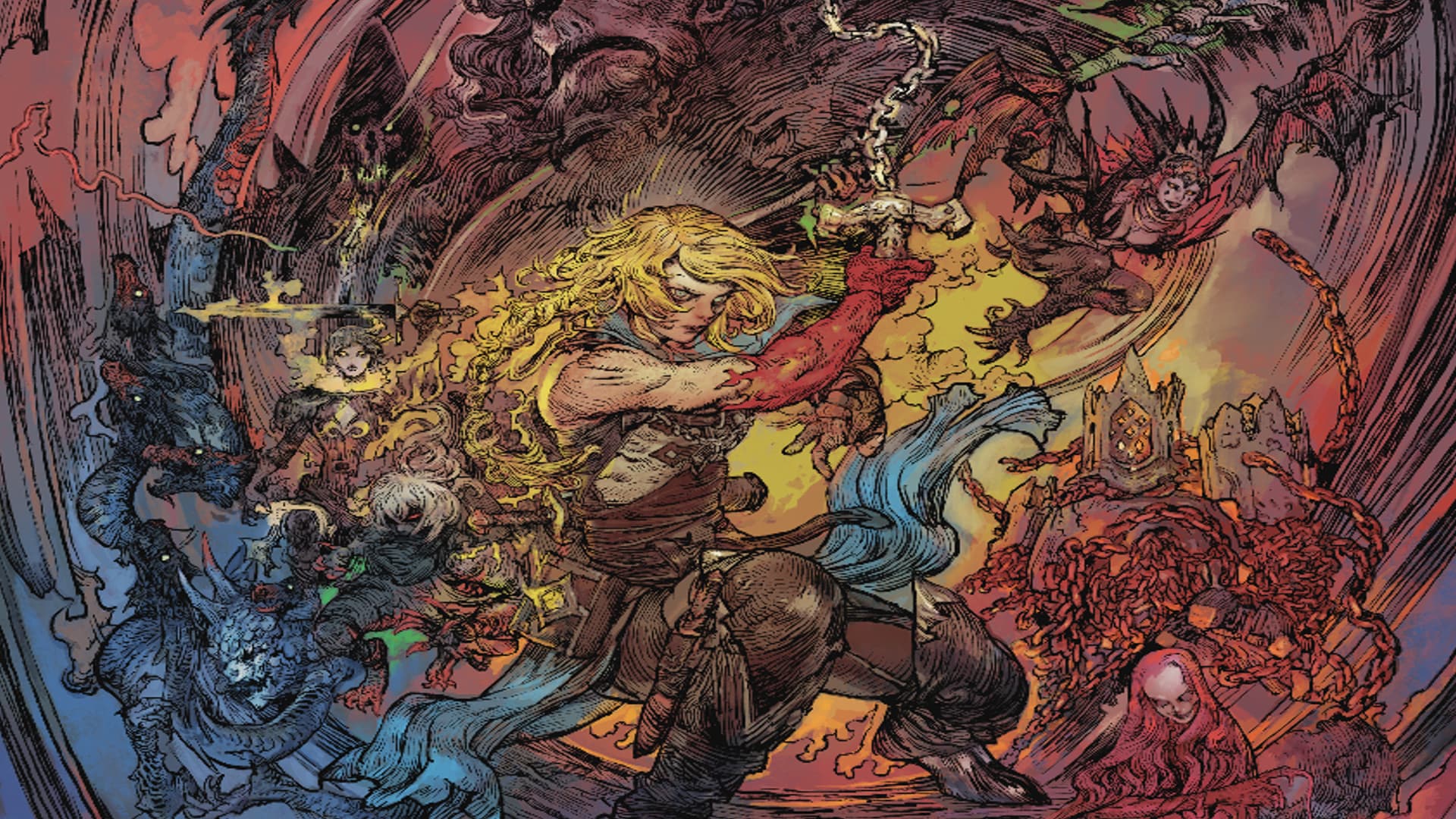
Castlevania: Belmont’s Curse is the Castlevania game I’ve waited the last 18 years for. This is the first real metroidvania-style Castlevania game since Castlevania: Order of Ecclesia released in 2008. While there have been offshoots and side games in the series, none of them fully brought back the excitement I felt for the series. Konami and the developers at Evil Empire have done an amazing job bringing together older games from the franchise with the aesthetic created by the Netflix Castlevania series. While the newer action-based combat style may differ from what some fans of the series are used to, Castlevania: Belmont’s Curse brings the spirit of Castlevania to the modern metroidvania stage.
The Belmonts vs. Dracula

Castlevania: Belmont’s Curse takes place in Paris, France, during an invasion of demons, monsters, and vampires. Rose Belmont is introduced as the daughter of Sypha Belnades and Trevor Belmont, two of the main characters from the Netflix Castlevania series. As Rose explores Paris and eventually Dracula’s castle, the game introduces the player to the story of the Belmonts by showing off characters from earlier games in the series. This allows for fans of the games and the animated series alike to feel a connection to this new entry.
The storytelling in the game not only ties in previous titles, but also fills in some narrative holes that have been around for far too long. For instance, Belmont’s Curse explains what happens to certain protagonists after their games end. We learn that one went on a journey to seal something dark away from the world, and it didn’t end until he was a frail old man, while another was cursed by Dracula and disappeared from the world altogether. While this may not seem like much to everyone, knowing that this lore is finally out after so many years is amazing to long-time fans.
An interesting story element is that as Rose defeats different bosses, she stores their power and souls in tarot cards, giving the bosses the ability to talk with her. And talk they do, as each character is fully voiced and lets Rose know how they feel about her. I enjoyed learning about the characters that I’d fought against since I started playing the Castlevania series years ago.
The story that plays out is easily one of my favorites throughout the entire Castlevania franchise and kept me on the edge of my seat as I played. Belmont’s Curse does a fantastic job of not only bringing back older characters from the series, but also expanding on the lore that has been kept from fans for so many years. For the first time since the animated series, Castlevania has tied in not only the PS2 games that come canonically before it, but also explains the origins of the Belmonts and their eternal hunt for Dracula. With the new insights into the bosses, the numerous returning characters, and lore drops, I believe this is one of the best Castlevania experiences in terms of story alone.
Platforming, Whip Swinging, and Vampire Slaying

Castlevania: Belmont’s Curse perfectly encapsulates what it means to be a metroidvania. The game is full of tight platforming that ties into its puzzle-solving, while the combat is fluid, fun, and at times difficult. Throughout the game, I was having fun jumping, swinging, and dashing through Paris. While there were an unnecessary number of traps to be found in the game, the fluid movement made them enjoyable. Besides a few locations where Rose got stuck trying to drop through a platform, I found movement to be quick, exciting, and intuitive.
Puzzle-solving was also a blast. One of my favorite puzzles was one focused on astronomy due to how you had to find the answers. Some clues were given in writing, while others were pictures or even constellations found out the castle windows. One even had you combine points from three different pictures to get the answer, but at no point did it ever feel overbearing. An interesting point about this game is that some of the quest clues felt really difficult to understand, with the most notable being the mirror quest. While the clues did make perfect sense after figuring them out, if some of the clues didn’t just click with you immediately, there was a chance you’d go through the rest of the game not knowing how to solve them and miss out on some really powerful features like fast travel.
Early on in the game, Rose gains the ability to use a whip to swing on hooks and pull herself towards enemies. This becomes a major focus for both traversal and combat and is different from her actual weapon. For traversal, this allows Rose to speed through game sections, get higher than she normally could through the use of hooks and enemy anchor points, and activate certain items for puzzles. In combat, this allows Rose to quickly move from enemy to enemy and allows an attack that deals high damage and gives invincibility frames, allowing combat to stay fast and fluid. For the actual weapons themselves, Konami decided to move away from the slower attack style from previous entries in the series for a more action-based one.
Instead of each weapon type having one attack like in older games, Belmont’s Curse utilises seven weapon types, each with its own fighting style. The weapons have four ranks of power ranging from ordinary to legendary, with legendary-ranked weapons each having a special gimmick like extra hits or homing attacks. I tried to use each weapon as I unlocked them and found they all worked really well, but I did have my favorites. Of the weapons, I liked the whips and lances most by the end of my playthrough due to the types of attacks they allowed me to pull off and the special abilities the legendary weapons had.
Along with a more modern combat style, the sub-weapons from previous games in the series have changed. Instead of the normal cross, axe, holy water, etc. from the bag of sub-weapons, Rose now utilizes her tarot cards. Each card is filled with a different boss’s power, allowing her to utilise skills like summoning blood spikes, freezing enemies, or tearing apart dimensions with a giant scythe. Each skill can then be upgraded into a stronger version as challenges are completed throughout the game. The skills are also utilised in certain puzzles, making them important to both combat and puzzle-solving. While I’ve always enjoyed the sub-weapons from previous entries, I felt that Rose’s tarot cards were a good and comfortable addition to the series that didn’t feel too far from what the series has done before.
That “Castlevania” Vibe

Castlevania as a series is known for its sometimes confusing lore, gothic-inspired art, epic characters, and its baroque-gothic-rock music. While the game looks fantastic, especially for those who are coming straight from the animated series, for those expecting the legendary Castlevania music, the game might feel a little different at the start. While the epic good-versus-evil vibes exist right from the beginning, the music is much more toned down initially and is set up to be more atmospheric. The music starts to shine during boss fights and when Rose finally enters Dracula’s castle. The bosses have their own high-intensity music that fits into the Castlevania theme, and for the castle itself, the legendary Bloody Tears starts playing as if to welcome players back to where things began.
Instead of just baroque-gothic-rock music, Belmont’s Curse raised the tempo with some newer trap and hip-hop-infused versions of classic Castlevania songs. This newer style added in energy that kept up with Rose’s more fluid and fast-paced movement without changing the feel that the Castlevania games normally give off. Even with this more modern change, I felt the music still honored the classic feel the Castlevania has always been known for.
From start to finish, the game’s art is beautiful. Paris is shown to be destroyed and burning in the background, while up close Rose is fighting her way through beautifully designed locations full of enemies. What really stands out are some pictures found within Dracula’s castle depicting characters and story moments from the series’ history. While the game has taken the art in a slightly new direction, these pictures follow the older style and prove it deserves to stay. While I like the new art style for Belmont’s Curse, I love that they honor the series’ past and let us see the two together.
Final Verdict

I enjoyed almost all of my time with Castlevania: Belmont’s Curse. The art, music, and story kept me immersed throughout my playthrough. While I was a little skeptical about combat due to the trailers I’d seen making it look more like a 2D Soulslike, the game handles it well. Instead of the departure I expected the combat to be, the fighting felt more diverse and fast-paced while still straightforward enough for a Castlevania game.
The platforming was fun and never felt boring. While traps might have been a bit too frequent, the fluid platforming allowed me to traverse most of them with relative ease. The only real downside I encountered were some overly cryptic clues for a few puzzles. With this being the first new title added to the series in so long, I hope the dev team can get another chance to work with the series, because Castlevania: Belmont’s Curse might be my favorite game for 2026, and is easily one of my top 5 games for the whole series.
Castlevania: Belmont’s Curse was reviewed on PC with a code provided by Konami. It is also available on Nintendo Switch 2, PlayStation 5, and Xbox Series X.
More From Us
After More Than 30 Years, BioWare Has Officially Been Shut Down
The Review
PROS
- Iconic art style and music
- Tight and smooth platforming
- Fast and fluid combat
- Consistent difficulty for puzzles and combat
CONS
- Some cryptic puzzle clues


