

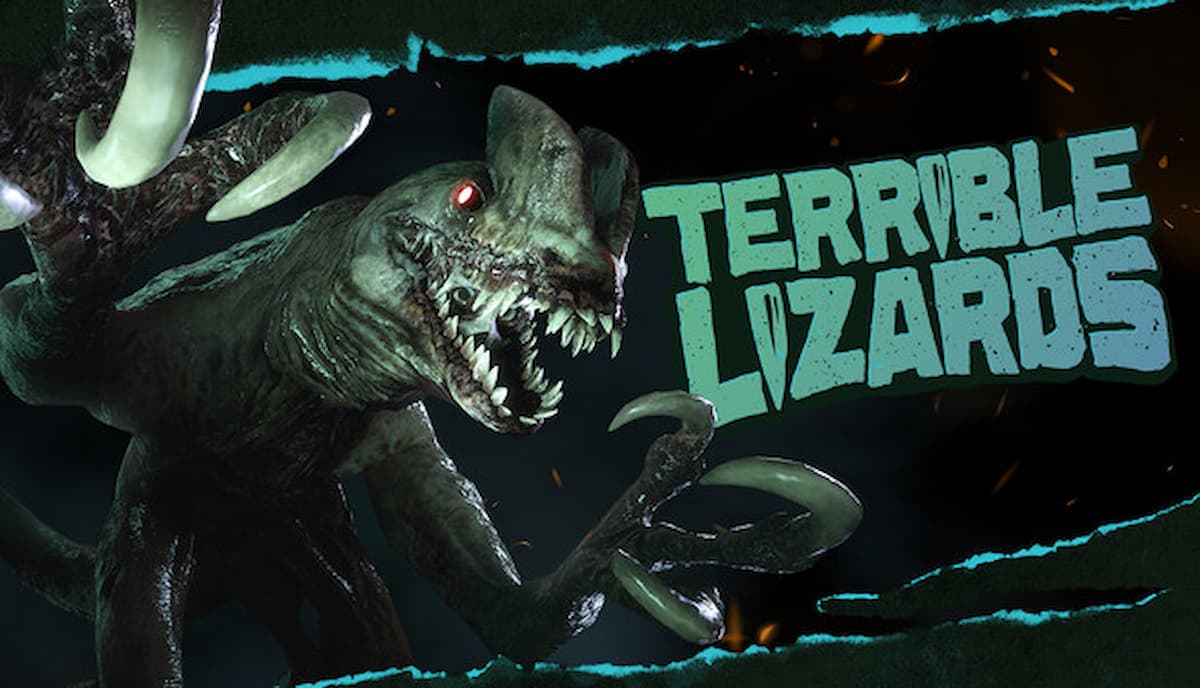
Route 66 is famous for a wide array of attractions meant to entertain people of all ages. Dalton’s Dinos happens to be one of those beloved attractions, but it’s one that takes you off the beaten path and pulls you deeper into its depths thanks to a dark, Jurassic-sized secret. Terrible Lizards was a game that I was eager to sink my teeth into simply because, well, who doesn’t like dinosaurs? While the game kicks off with mystery and allure, glaring issues beneath the surface keep it from living up to its potential.
Dalton’s Dinosaur Menagerie
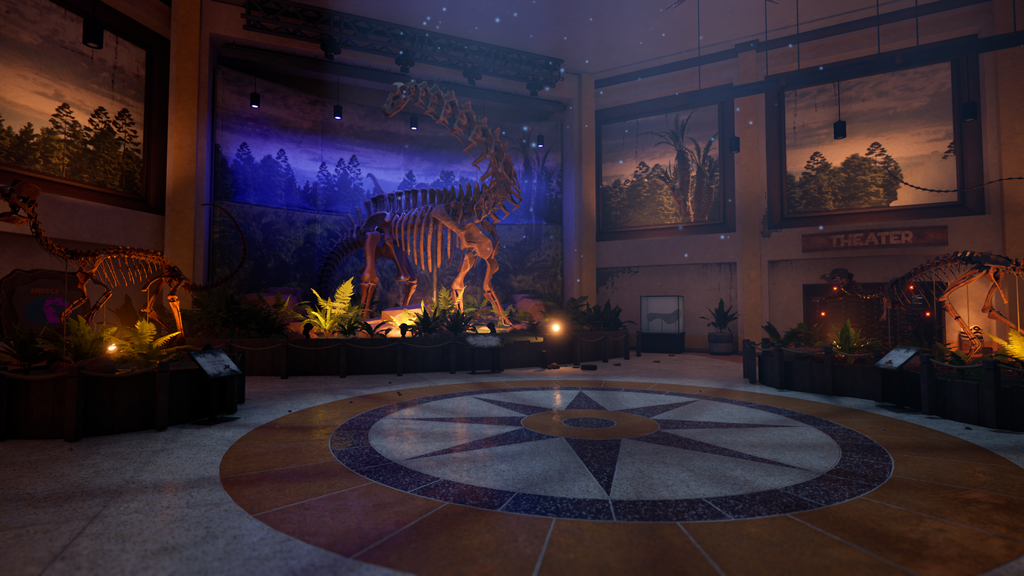
Terrible Lizards puts you in the shoes of a young track star named Jordan. As fate would have it, his car breaks down on an eerie stretch of road in New Mexico. The year is 1992, so there are no cell phones. He must find a local payphone, call a tow truck, and wait it out. Luckily, or unluckily, Dalton’s Dinos is right across the street and is home to an awe-inspiring display of fossils and life-like animatronic dinos that all came together to make a setting I really enjoyed.
The environment that is set up within the first 20 minutes of the game is some of the best, simply because of the unsettling nature of being surrounded by these mechanical beasts. In my early years, I frequented exhibits just like Dalton’s Dinos, and the team really did a great job capturing not only the size but the scale of the attraction. As I wandered deeper into these exhibits, I got weary of these robotic counterparts simply because I knew a scare was coming but had no clue when or where that would happen.
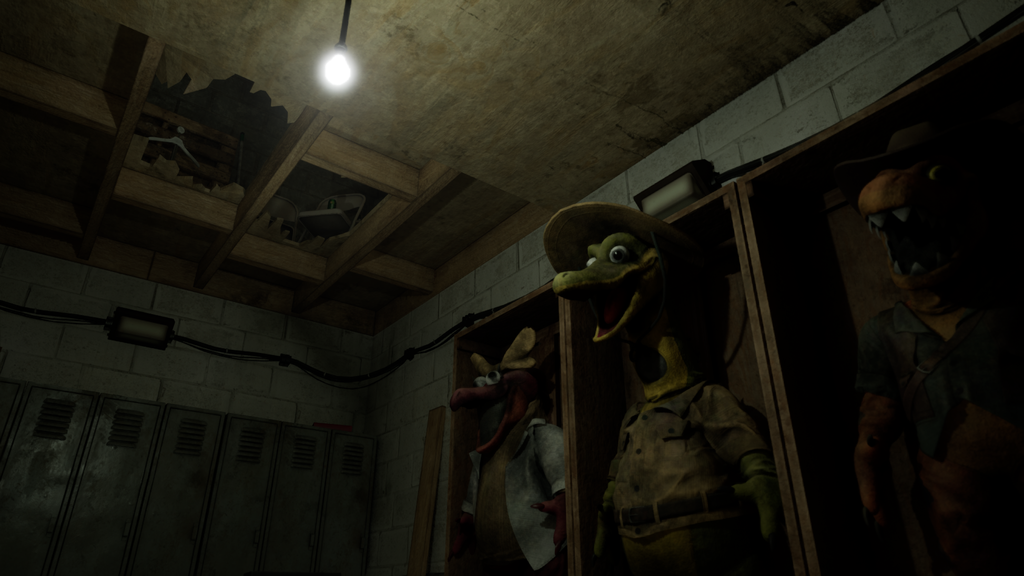
This is where I really would’ve loved to linger around the show floor a bit more because what the game did so well is mask some cheap jump scares that certainly got me a time or two, like the sequence in which you walk down the narrow corridor of the raptor exhibit where you are flanked by animatronics that randomly lunge at you from the shadows. Later on, the game drip-fed me actual unsettling moments like being stalked by a mysterious entity in a mascot suit.
As you make your way through the story, you slowly uncover more of the mystery, which forces you deeper into the dig site that lies below the attraction, and the game spends far more time in the depths rather than in the attraction itself. I think it would be better to spend more time upstairs because the developer struck such a great mix of threats, from actual tangible threats like mutated dinosaurs and the animatronics, which really left me in a constant state of uneasiness.
Another bright spot is the attention to detail within the various audio and video logs you find throughout your journey. When you first enter Dalton’s Dinos, you’re greeted with a campy introduction video to the exhibit, which is a clear nod to Jurassic Park. From there, you constantly find video logs from Dalton himself as he recounts his quest to find his son, and it was a pleasant surprise to come across the former YouTuber MatPat, who stars in a few of these clips.
Jumping and Running to Conclusions
The biggest issue I had with Terrible Lizards was its controls. It prides itself on being a parkour-first game with no combat. For a fair chunk of my playthrough, things were great. Movement felt fast, fluid, and chase sequences weren’t clunky, but as the game asked you to do more, such as climbing, sliding, shimmying across rafters, wall running, and bouncing on black goop, this is where the experience started to derail for me.
The momentum system used within this game was very unreliable, as there were moments where it worked flawlessly and I made all the proper jumps and hit a flow state, but there were other times when it would really sour key moments in the story by overshooting a jump or not allowing me to take the jump at all, resulting in a game over.
Carnivore Horrors

The stars of the show are various mutated dinosaurs you run into as you venture deeper into the lower levels. These creatures were lost to time itself, being encased in an underworld of their own until Dalton’s quest for riches unearths them. These range from a pretty scary Allosaurus to a human-raptor hybrid. Looks-wise, they live up to the hype. These monsters are scary and would make anyone run for their lives. Sadly, the AI brain controlling them was clearly lost in the fossil record.
This issue was most apparent during my encounters with the Allosaurus boss. There is a specific sequence where you are tasked with gathering fuses in order to find a way out, and the general concept of these boss battles is to stay out of their line of sight. If you fail to do so, they’ll make a beeline for you, and the game places specific obstacles or hiding spots to slow them down. However, in this sequence, there were a few times when I’d be found, go hide, and the enemy would just lurk outside my hiding spot and give me no path to exit. In another instance, the AI just seemingly stopped dead in its tracks to have an awkward staredown with me and suddenly made a break for me, ruining the bit of immersion I had.
Final Verdict
Overall, Terrible Lizards has an enjoyable environment and creepy atmosphere, but AI bugs and a shaky parkour system really hampered the experience for me. For a game that prides itself on parkour and staying away from combat, these two things should’ve been refined further. The setting of the Dalton’s Dinos attraction stands out to me as one of the best horror settings I’ve been in and left me wanting more, and the lore built into this title through its various levels had me invested in the outcome of this mystery right up until the very end, which makes it a game that I can recommend, but with a few concessions.
Terrible Lizards was reviewed on PC with a code provided by WDR Studios. It is also on PlayStation 5 and Xbox Series X.